
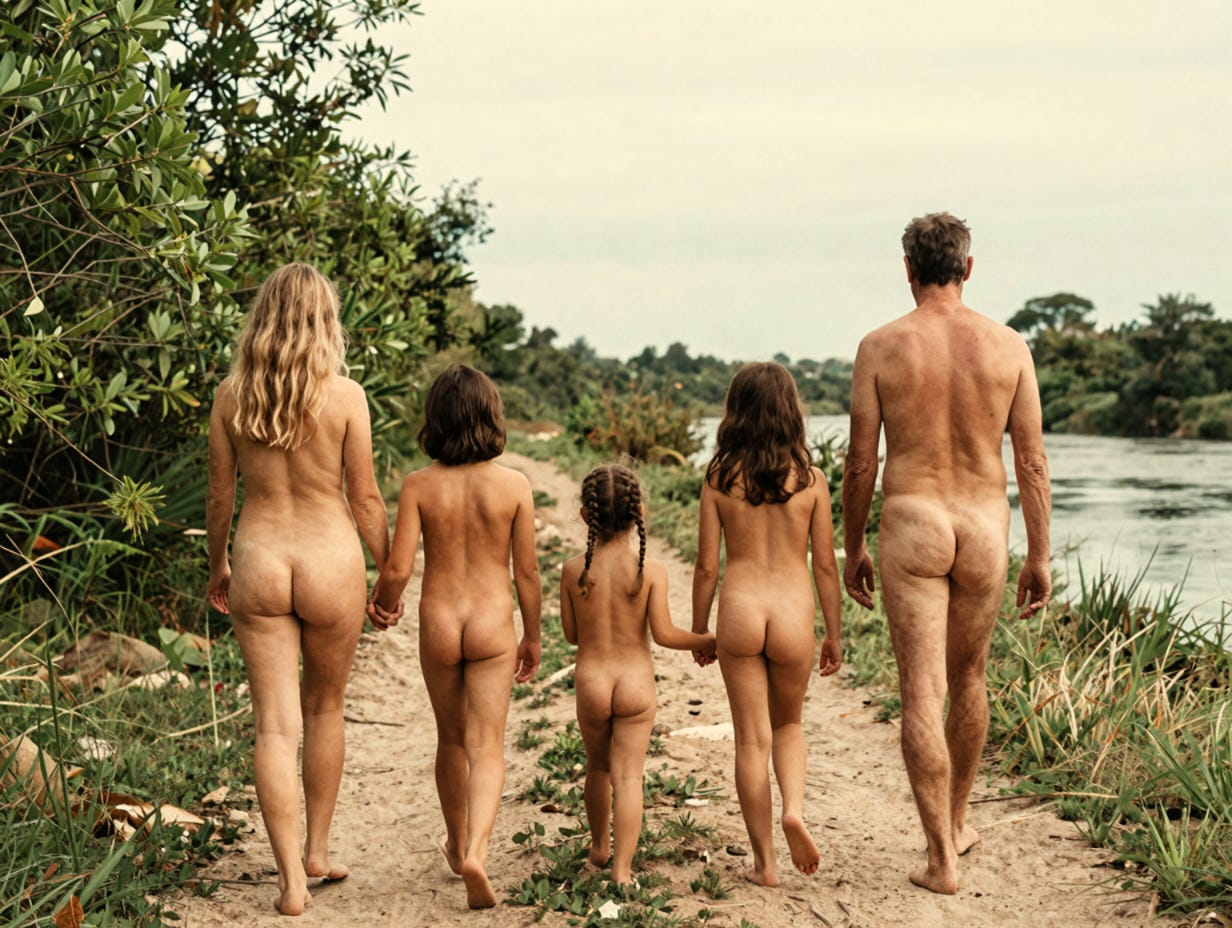
Today, I’m starting a new series on raising children as Christian Naturists. I’m sharing this yarn carefully and prayerfully, knowing full well that folks reading this come from all sorts of tracks and backroads. Some of you have been in the church since you were knee‑high. Some have drifted away. Some are dipping a toe into Christian Naturism for the first time, and others have been living it quietly for years. Wherever you’re standing, you deserve a place where we can talk about faith and the body without fear, shame, or someone breathing down your neck.
And look — I’m not going to pretend I’m neutral here. I am trying to stir the pot a little. I am hoping to persuade you to rethink some things we’ve all taken for granted. Not because I’m chasing a lifestyle trend, but because after decades as a pastor, a husband, a dad, and now a granddad, I’ve learned that God turns up in places no one ever thought to look. The values I used to preach from the pulpit — dignity, trust, honesty, embodied faith, mutual respect — I’ve seen them lived out in surprising ways, especially among people who’ve stopped hiding and started living with a bit more freedom.
This isn’t a blueprint or a demand for agreement. I’m not asking you to chuck your convictions or swap them for mine. Families differ, consciences differ, and wisdom always has to fit the context you’re in. What follows is simply a testimony — one bloke’s lived experience, offered with humility — for anyone willing to sit at the table, listen, reflect, and discern what’s good, true, and life‑giving in their own walk with God.
Pull up a chair, mate. Let’s start this the way all good yarns start — with a story. I didn’t wander into Naturism because I was chasing something wild or trying to shock the neighbours. I wasn’t looking to be controversial, rebellious, or clever. I came to it because I was trying to be faithful — faithful to God, loyal to my family, and faithful to the body I’d spent most of my life treating as a problem rather than a gift.
Like most Christians, I grew up breathing in a particular set of assumptions without ever realising it. If something made you uncomfortable, it must be spiritually dangerous. Bodies were suspect. Skin was suspicious. And if you ever felt too at ease in your own flesh, well, that was probably a trap waiting to spring. No one needed to spell it out. The message was just there, woven into sermons, youth talks, dress codes, and sideways glances.
If parts of this make you uneasy, that’s understandable — it certainly did for me at first. For years, I didn’t question any of it. Why would I? It was the air we all breathed. It felt normal. Sensible. Protective. But life has a funny way of tapping you on the shoulder when you least expect it. For us, that tap came quietly. It showed up in small moments — moments when my family felt more relaxed, more honest, more ourselves when we weren’t busy managing appearances. Times when no one was performing, no one was hiding, and no one was trying to look holier than they actually felt. Naturism didn’t create those moments. It simply made room for them. And once we noticed that, we couldn’t un‑notice it.
One of the first things that hit me — and hit me hard — was realising just how much fear I’d absorbed about bodies over the years. Not from Scripture, mind you. From culture. From church habits. From unspoken rules we all learned without anyone ever sitting us down and saying them out loud.
In naturist spaces, that fear doesn’t survive very long. Bodies are just bodies. Ordinary. Varied. Scarred. Ageing. Sometimes awkward. Sometimes strong. Beautiful in the way gum trees are beautiful — not because they’re perfect, but because they’re real and alive and rooted where they stand.
Kids pick this up almost immediately. They don’t see bodies as trophies to show off or something anyone needs to control. They see them as part of being human. No drama. No panic. No fuss.
And as a Christian, that landed deep. Because it lined up with something I’d preached for years but never fully lived in my own skin — the simple truth that God called creation good before anyone ever called it fallen.
As a dad — and now a granddad — I’ve always wanted to raise kids who are wise, not just compliant. I’ve learned the hard way that fear‑based faith can make people behave for a while, but it rarely makes them discerning. It teaches them how to avoid trouble, not how to live well.
What I saw in healthy naturist families was something different altogether. Conversations replaced silence. No one treated questions like threats. Boundaries were named clearly, not hinted at or wrapped in shame. Adults taught privacy as wisdom, not as panic or embarrassment. Adults didn’t enforce respect through control — they expected it because they lived it first.
No one trained kids to hide parts of themselves. Adults taught them to speak, to ask, to notice, and to trust. And if I’m honest, that looks a lot more like Jesus than much of the fear‑driven formation many of us grew up with.
Modern culture has a strange habit of telling two lies at the same time. On the one hand, it tells us that bodies are everything — our worth, our identity, our currency. On the other hand, it insists that bodies are dangerous and need constant policing. The church, often well‑intentioned, tends to respond by going quiet — as if silence will somehow keep kids safe.
Christian Naturism refuses both lies. By separating nudity from sexuality, it quietly defuses the shame bomb. Adults meet curiosity with guidance rather than alarm. Language stays honest. Adults treat sexuality with seriousness and respect, not secrecy or fear. Shame thrives in silence. Health grows in clarity.
What I witnessed wasn’t moral looseness. It was emotional maturity—relational maturity, the kind of groundedness that grows when people stop hiding.
Now, I’m not going to pretend that Naturism fixes every problem or turns us into saints overnight. It didn’t. We’re still human. Still learning. Still stumbling our way toward grace like everyone else. But it did give us something precious. It gave us a shared language of honesty and respect. It slowed us down in a world that’s always rushing. It helps us stop performing and start being present with one another. It reminds us that faith isn’t something you hide behind — it’s something you live in your own skin.
And maybe the biggest surprise of all was this: it helped us show our kids — and now our grandkids — that following Christ isn’t about shrinking yourself or covering up who you are. It’s about becoming whole.
Here’s something I never expected to say out loud. Some of the Christian values I spent years preaching — honesty, humility, respect, equality, care — I’ve seen lived more naturally in naturist communities than in some church spaces.
Not because naturists are better people.Not because the church is bad. But because when you take away layers of performance and fear, people tend to show up as themselves — and that’s where grace does its best work.
Because God never made the body the bad bloke in the story, and He never meant shame to be the one teaching us. Fear‑based formation does more harm than good, especially for children who are still learning what it means to be known and loved. Scripture calls us toward lives lived in the open — lives shaped by truth, grace, and trust rather than hiding and anxiety. And the gospel, at its heart, is good news for the whole person, not just the parts we’ve learned to keep respectable.
In the chapters ahead, we’ll talk honestly about bodies, boundaries, Scripture, family life, and how faith can be lived without fear or shame.
Because once you begin to see the goodness of the body the way God intended, it becomes very hard to go back to pretending it’s a problem. This series isn’t about being radical. It’s about being faithful.
Faithful to Scripture.
Faithful to our kids.
Faithful to the God who made us — skin and all.
So pull up a chair, mate. Let’s walk this road together — honest, unhurried, unhidden.
ANOTHER GOOD POST
I’m a Christian and fully intend to raise my kids in a naturist environment. My family is comfortable with nudity at home. It’s just normal for us.