BARE fAITH 9
9 — The Critics: Listening Without Losing Yourself

There comes a point in every naturist parent’s life when the critics show up. Sometimes they arrive with genuine questions. Sometimes with concern dressed up as advice. Sometimes with a tone that tells you the verdict was settled long before you ever opened your mouth. If you’ve lived long enough, you learn to hear the difference. Some people are curious. Some are cautious. And some aren’t really reacting to you at all — they’re reacting to what your choices stir up in them.
This chapter isn’t about winning arguments or sharpening replies. It’s about learning how to stay awake to what’s real without losing yourself in the noise. It’s about knowing when to listen, when to let something pass, and when to walk away without carrying someone else’s fear home with you.
I’ve lived long enough, and I’ve loved the church long enough, to say this without flinching: over the years, I’ve sometimes found more honesty, respect, and humility in naturist communities than I have in certain church spaces. Not because the church is bad, and not because naturists are somehow better people. I’ve known church leaders who embodied deep respect and clarity, and when that happens, it’s a beautiful thing. But I’ve also seen how easily shame can slip into religious rooms and start calling itself holiness. Once you’ve seen that clearly, you stop falling for it.
One of the first things that struck me in naturist spaces was how respect moved sideways rather than downward. No one stood above anyone else. No one used modesty as a measuring stick or treated bodies as spiritual liabilities. People looked one another in the eye. They listened. They didn’t posture or perform. It wasn’t utopia — just ordinary human beings meeting each other without armour. I didn’t always find that same ease in church hallways, where respect sometimes came with conditions: dress this way, speak this way, fit this mould. In naturist spaces, respect wasn’t something you earned. People gave it freely because you were human.
Critics often assume naturism erases boundaries, but in my experience, it does the opposite. When you take shame out of the equation, boundaries settle into place rather than blur. People say what they need without drama. People hear what others need without offence. There’s less tiptoeing and less hiding behind politeness. I’ve watched naturist communities handle boundaries with more maturity than some church committees I’ve sat on — not because they were wiser by nature, but because they weren’t afraid of bodies. Fear makes boundaries rigid. Shame makes them brittle. Respect makes them strong and flexible at the same time.
Accountability surprised me most of all. In healthy naturist communities, when someone crosses a line, it’s addressed directly and calmly. There’s no spectacle, no gossip, no public shaming. The goal is restoration, not humiliation. I’ve sat in church meetings where accountability meant embarrassment and silence afterwards. I’ve sat in naturist circles where accountability meant responsibility and repair. I know which one felt closer to the spirit of Jesus.
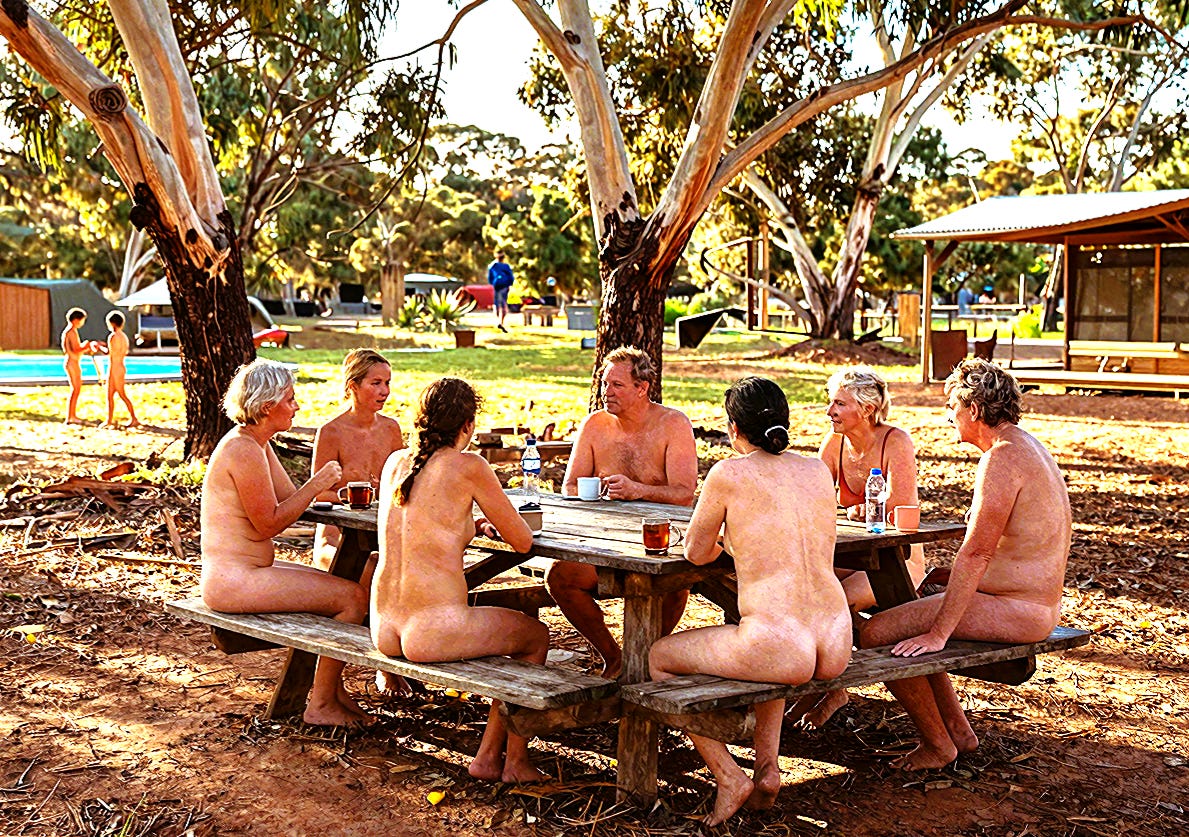
I remember one afternoon at a naturist camp years back. Nothing dramatic — warm day, kids splashing in the pool, families chatting, that low hum you get when no one’s in a hurry. A bloke in his fifties wandered over. You could see he’d been wrestling with something. He cleared his throat and said, “I reckon I crossed a line earlier. I didn’t mean to, but I made someone uncomfortable. I’ve apologised to her, but I wanted to say it here too. I’m still learning.”
That was it. No excuses. No defensiveness.
No one jumped on him. No one whispered. No one turned it into a spectacle. One of the older women nodded and said, “Thanks for owning it. That’s how we keep this place safe.” And then the conversation drifted back to whatever we’d been talking about. Not because it didn’t matter, but because it had been handled properly.
I remember thinking how different that felt from some church meetings I’d been part of. In those rooms, a moment like that could have turned into an inquisition. People picking sides. People getting quiet. Shame doing most of the talking.
But here — in a place plenty of Christians would write off as morally suspect — I watched accountability handled with more honesty, humility, and common sense than I’d seen in some of the rooms where I’d spent half my working life. That moment didn’t make me bitter about the church. It just woke me up. It showed me that respect doesn’t need a pecking order. Boundaries don’t need fear to hold them up. And accountability doesn’t need shame to work. Sometimes it just needs people willing to own their stuff and others willing to let that be enough.
So when the critics speak, you don’t have to harden your heart, and you don’t have to defend your entire life in one conversation. You can listen. You can acknowledge the parts that are fair. You can even thank them for their concern. And then you can walk away with your centre intact.
You don’t owe anyone your shame.
You don’t owe anyone your fear.
You don’t owe anyone your self‑doubt.
You can listen without absorbing.
You can stay open without becoming porous.
You can remain kind without making yourself small.
I’m not angry at the church, and I’m not disillusioned. I’m not carrying a grudge or trying to burn anything down. I’m just awake. I’ve seen what shame does to people. I’ve seen what fear does to families. I’ve seen what silence does to kids. And I’ve also seen what happens when people step into a different kind of light — not the harsh glare of judgment, but the warm, honest light of being fully human among others.
Naturism didn’t make me cynical. It made me clear‑eyed. It taught me how to recognise respect when I see it, fear when I hear it, and shame when it tries to dress itself up as concern. And it taught me this: you can love the church deeply and still tell the truth about the places where it struggles. That isn’t betrayal. It’s integrity. And if you’ve lived long enough to stop pretending, you know the difference.
well spoken and fits back to what i had said to you before
Today’s sermon scripture, I was a little disappointed that the priest didn’t take it MY way…
Matthew 6:25-34
“Therefore I tell you, do not worry about your life, what you will eat or drink; or about
your body, what you will wear. Is not life more than food, and the body more than
clothes? Look at the birds of the air; they do not sow or reap or store away in barns, and
yet your heavenly Father feeds them. Are you not much more valuable than they? Can
any one of you by worrying add a single hour to your life?
“And why do you worry
about clothes?
See how the flowers of the field grow. They do not labor or spin. Yet I
tell you that not even Solomon in all his splendor was dressed like one of these. If that is
how God clothes the grass of the field, which is here today and tomorrow is thrown into
the fire, will he not much more clothe you—you of little faith? So do not worry, saying,
‘What shall we eat?’ or ‘What shall we drink?’ or ‘What shall we wear?’ For the pagans
run after all these things, and your heavenly Father knows that you need them. But seek
first his kingdom and his righteousness, and all these things will be given to you as well.
Therefore do not worry about tomorrow, for tomorrow will worry about itself. Each day
has enough trouble of its own