BARE FAITH 7
Talking to Grandparents, Churches, and Friends

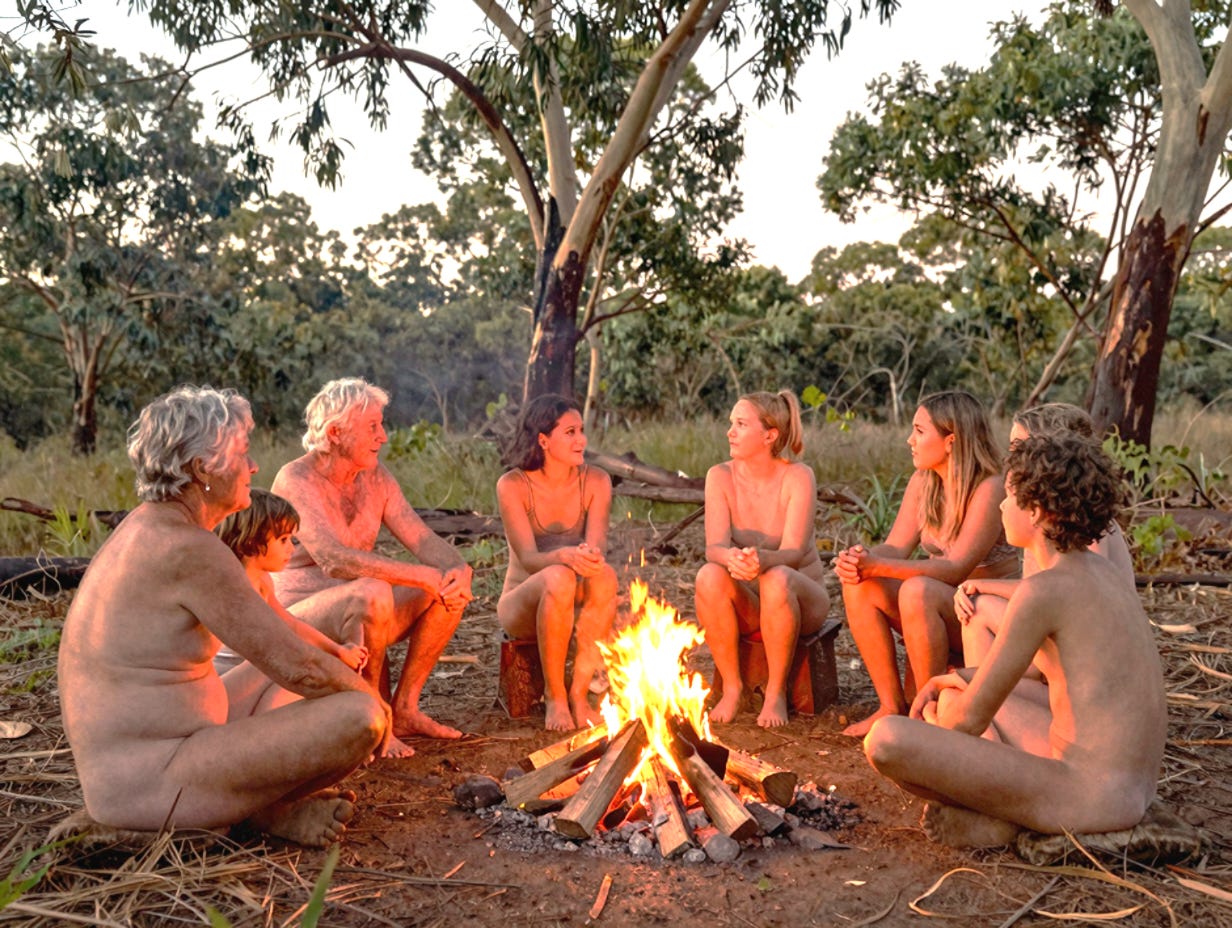
Some conversations roll along easy, like a yarn over a cuppa. Others make you take a breath before you open your mouth. This chapter is for those ones — the conversations that sit a little heavier in the chest because they touch family, faith, history, and belonging all at once.
They’re the talks with grandparents who love your kids fiercely and carry their own mix of memories — some shaped by years of tightening rules and quiet caution, others by a time when bodies were less feared, and freedom sat closer to the surface. They’re the careful conversations with church friends who’ve inherited particular ways of thinking about modesty and faith, often without ever having reason to question them. They’re the moments at school pick-up or birthday parties when someone tilts their head just slightly after you mention your weekend, and you can feel the unspoken question hanging in the air.
This is where we pull up a chair around the campfire and talk about how to walk through all of that without losing your peace, your patience, or your sense of self. These conversations matter not because you need to win them, but because they shape the atmosphere your kids grow up in. They teach your children how to hold their own convictions without becoming combative, and how to stay gentle without becoming invisible.
One of the hardest things to accept is that some people simply won’t understand. Not because they’re cruel or closed-hearted, but because Naturism brushes up against assumptions people carried and reinforced long before anyone stopped to ask where they came from. You can live with integrity and still unsettle people whose childhoods taught them to see bodies as problems waiting to happen. You can raise confident, grounded kids and still confuse someone who learned early that comfort in your own skin is suspicious. Sometimes the tension you feel in these conversations isn’t about you at all — it’s about the stories they inherited and never had the chance to question.
And yet, it’s worth remembering something that often gets overlooked in these conversations: many grandparents grew up in the 1960s and 70s — a time when Naturism, body freedom, and non-sexual nudity were far more visible and less feared than they are now. For plenty of them, this isn’t unfamiliar ground. They remember skinny dipping in creeks, free beaches, naturist magazines on newsstands, and a cultural moment when people met the human body without trying to control it or turn it into a problem.
Some grandparents aren’t confused — they’re cautious because life taught them to be. Others are quietly amused that the conversation has come around again. And some, once you get past the assumptions, nod slowly and say, “Yeah… we had our own version of that once.” What looks like resistance can sometimes be memory, experience, or simply the weight of years lived in a world that gradually tightened the screws.
As Tom said, “When our son told us they were raising the kids in a naturist way, he braced himself like he was delivering bad news. I had to laugh. I grew up in the seventies — half the neighbourhood ran around in the backyard without clothes, and no one thought twice about it. We swam in creeks, changed behind towels at the beach, and no one made a fuss. So when he finally got the words out, I just said, ‘Alright. Sounds pretty normal to me.’ What struck me most was how relaxed the kids were. No awkwardness. No shame. Just the kind of ease I remember from my own childhood before everything got so complicated. I think they expected a lecture or a raised eyebrow, but honestly? I’m glad they’re giving their kids something the world seems to have forgotten — the freedom to feel at home in their own skin. If anything, I’m proud of them for choosing peace over panic.”
Understanding, though, still isn’t a prerequisite for respect. Not everyone needs to “get it” for you to live well. Your job isn’t to convert grandparents, persuade church leaders, or convince the school gate committee that you’ve found the one true way. Your job is much simpler, and much harder: to live faithfully, gently, and without apology. Sometimes the most settled thing you can say is, “It works for our family, and we’re at peace with it.” Said calmly, without edge, that line often does more than a hundred explanations ever could. Sometimes, the most faithful thing you can do is let time tell the story your words never could.
Kids, in particular, don’t need you to arm them with arguments. They don’t need a theology lecture or a stack of proof texts to carry into the playground. What they need is language that’s true, steady, and age-appropriate — words that don’t wobble when spoken out loud. When a child can say, “God made our bodies good,” or “We don’t hide because we’re ashamed — we just use privacy wisely,” adults aren’t training them for arguments. They’re giving them a foundation that helps them stand steady. When they can say, “Different families do things differently, and that’s okay,” they learn early that difference doesn’t have to mean danger. They learn that respect isn’t something you earn by conformity, but something you offer because people matter. Kids learn as much from how we hold these conversations as from what we say.
Those simple truths are deeply biblical, even if they don’t sound like church talk. Scripture’s steady refrain has always been that creation is good, bodies are part of that goodness, and shame never leads anyone toward wisdom. Kids who carry that truth don’t feel the need to argue. They just live it. And when they live it with quiet confidence, adults often soften more than they expect. A settled child can disarm a lifetime of anxiety without saying much at all.
As adults, one of the skills we have to relearn is discernment — knowing when to speak and when to let something slide. Not every comment needs correcting. Not every raised eyebrow deserves a response. Some questions are genuine invitations, asked by people who are curious and open, even if they don’t yet have the language for it. Those are often worth leaning into slowly, with patience and warmth.
Some comments aren’t really questions at all. They’re just people reacting out of unease, or trying to hold on to what’s always felt familiar to them. You don’t need to push back against that, and you don’t need to fix it. Sometimes the wisest response is to let it pass. Sometimes it’s a simple change of subject. And sometimes it’s a steady, “We’re comfortable with our choices,” and then you move on with your day. Discernment isn’t avoidance. It’s stewardship. It’s knowing when a conversation will build peace and when it will only drain it.
Underneath many of these interactions sits a quieter fear, one that rarely gets named. It’s the fear of not belonging. The worry about being “the weird family.” The anxiety that living differently must somehow mean living wrongly. But Scripture tells a different story. The Bible is full of people whose lives made others uncomfortable — prophets who spoke sideways to power, poets who refused tidy answers, wilderness wanderers who trusted God outside the city walls, early Christians who wouldn’t play by the empire’s rules.
Difference has never been the enemy of faith. Shame has. If your choices are rooted in love, wisdom, consent, and dignity, you’re standing on solid ground, even if the path looks unfamiliar to others. Living differently doesn’t mean you’ve drifted. It often means you’ve listened more carefully.
So as you head into these conversations — with grandparents, with church friends, with neighbours and colleagues — carry this with you like a quiet blessing. You don’t owe anyone defensiveness. You don’t owe anyone a debate. You don’t owe anyone a performance of normality that leaves you tight and tired. You owe your kids wisdom. You owe your family peace. You owe your own soul honesty.
And sometimes that honesty sounds like a campfire yarn — gentle, warm, unhurried — reminding the people you love that you’re not rebelling, not abandoning faith, not trying to shock anyone. You’re simply choosing a way of life that lets your kids grow without shame. And that, in any generation, is a story worth telling.
The wisdom woven into this article can (and should) be extracted and applied to any number of situations.
“Sometimes, the most faithful thing you can do is let time tell the story your words never could.”
Wow! There is a calming power in that single line.
I heard a similar statement many years ago and I know this isn’t it exactly, but it speaks to a man of integrity being wrongly accused and letting time prove him right.
The author shares his wisdom and experience, allowing us to grow and mature in our methods of communication. Although he does so much more. He reflects on the Biblical aspect of the “argument.”
I’m guessing most people who have issue with naturism are those who immediately reference some version of “And they realized they were naked and they were ashamed.”
The author provides a powerful tool in the suggested statement, “The Bible is full of people whose lives made others uncomfortable.” This isn’t a response we use to argue. Rather, it’s an understanding of our own self awareness and a level of authority to be different, and to understand that (and other) difference is okay.
It kinda reminds me of the sketch where a young child is peaking over folded arms and the words above him state, “I know I’m somebody.” And then, the words below say, “cause God don’t make no junk.”
We spend years teaching our children acceptance and love, then somewhere along the way, we teach judgement. Actually, they learn the judgment part by watching us grownups do exactly the opposite of what we teach them.
Much appreciation to the author for this insightful and very helpful article.
One line I heard recently from communication expert Jefferson Fisher is, "You don't have to attend every argument you're invited to." I had to remind myself of that yesterday when I got into a discussion with someone about my choice to be a naturist. Though I did choose to engage with him, I refused to argue, only clarify the most important misunderstandings, ask a few pointed questions, and then let the rest go. I trust that I planted a seed, and in God's time and way, He can water that seed and give the growth.