Bare Faith 3.
Why Kids Need a Theology of the Body Before Puberty

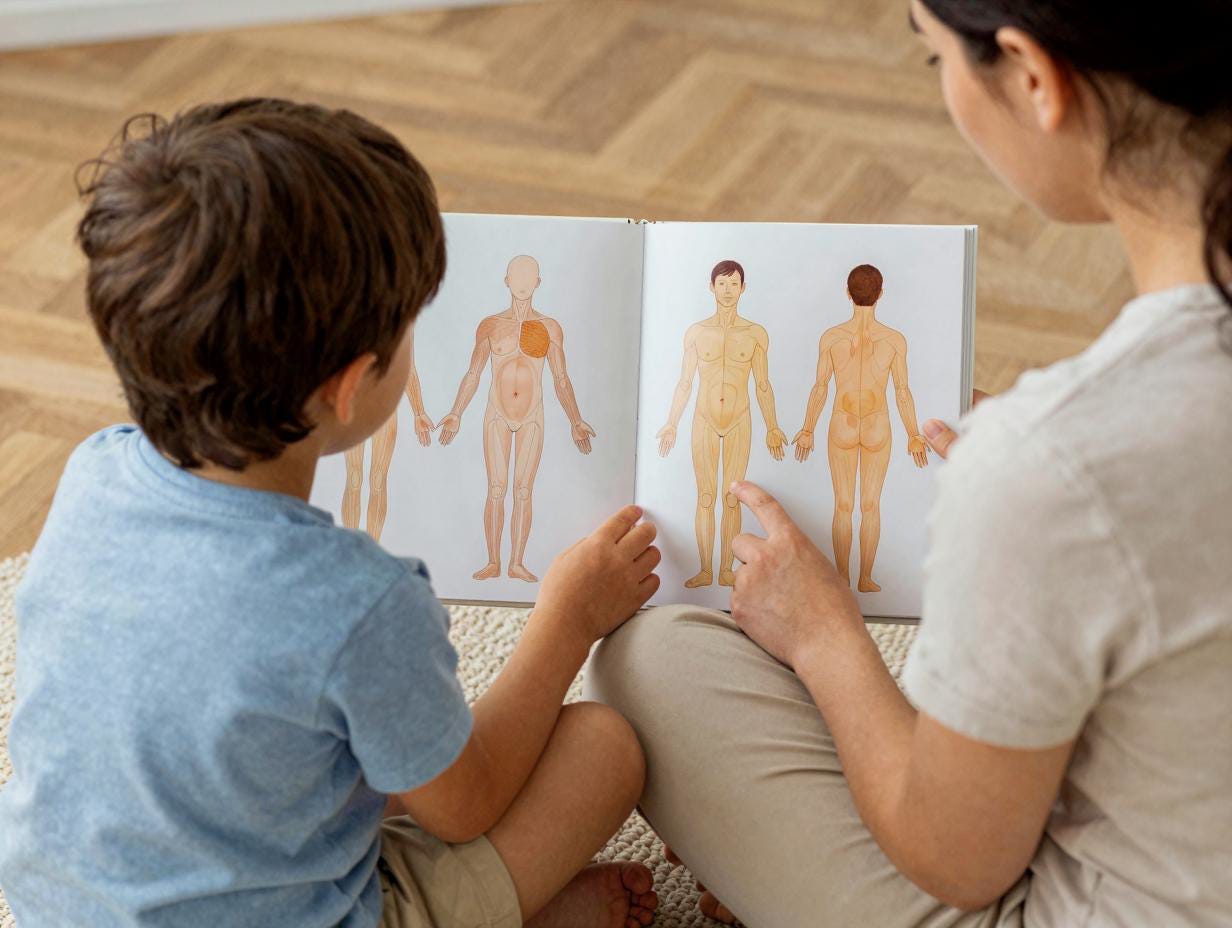
This chapter is for the parents around the table — the ones who’ve carried a lifetime of shame in their own bodies and are quietly determined not to pass it on. You can see it in their posture, the way they lean in a little closer when the conversation turns to kids. They’re not looking for loopholes or excuses. They’re not trying to win arguments. They’re looking for freedom — for their children, yes, but often for themselves as well.
Here’s the truth that tends to surprise them. Children begin forming their theology of the body long before they can spell the word theology. Long before they can name a feeling. Long before they know how to frame a question. Long before puberty ever knocks on the door. By the time hormones arrive, most of the groundwork is already in place.
Children are always learning, but rarely from lectures. They learn from atmosphere — from tone, from what gets named calmly and what gets avoided awkwardly, from the look on a parent’s face when a child points to a body part, from the way the room goes quiet when curiosity arrives. Whether we realise it or not, kids are constantly making sense of the world they live in. They’re little theologians long before they know the word.
Kids don’t need to be sat down and told that their bodies are shameful. All it takes is a flinch. Children read adults the way farmers read the weather. They notice the shift in temperature, the hesitation, the sudden change of subject. And because kids instinctively try to make sense of what’s happening around them, they fill in the blanks with whatever story feels safest. If Mum looks uncomfortable when I ask about this, maybe the problem is me. If Dad won’t say that word, maybe it’s a bad word. If everyone goes quiet, maybe I should too. Shame doesn’t need a sermon — it only needs silence.
That’s why the way we talk — or don’t talk — matters so much. Some parents worry that using proper anatomical terms will somehow sexualise their kids or rob them of innocence, but the opposite is usually true. When we use clear, ordinary language without embarrassment or drama, we’re telling our children that their bodies are normal and good, and that there’s nothing about them that needs to be whispered or hidden.
Kids who know the names of their body parts aren’t getting ahead of themselves. They’re finding their feet and learning to stand steady. They’re safer, more confident, and far less likely to be manipulated by anyone who relies on secrecy and confusion. Naming things clearly is one of the first acts of stewardship in Scripture. It’s how humans participate in clarity. It’s how we honour what God has made by refusing to pretend it doesn’t exist.
Most parents don’t intend to pass on shame. They’re not trying to make their kids afraid of their own skin. More often, they’re simply echoing what someone taught them — or, more accurately, the silence they grew up with. Over time, silence becomes the teacher, and it can be a harsh one. Children learn that some questions are unwelcome, some words feel too loaded to speak, and some parts of themselves get tucked away. Curiosity gets squeezed. Visibility feels risky. Being seen starts to feel dangerous.
By the time puberty arrives, the script is often already written. The body becomes a battleground instead of a home. Adolescence turns into something to survive rather than something to walk through with support. But it doesn’t have to be that way.
When people hear the word Naturism, they sometimes imagine chaos — kids running wild, no boundaries, no guidance, no wisdom. But that’s not what you’re talking about around this table. You’re talking about raising grounded children. Honest children. Children who don’t have to spend half their adult life unlearning fear before they can feel comfortable in their own skin.
At its best, Naturism isn’t about rebellion or shock. It’s about clarity. It’s about raising kids who don’t hide, who can speak openly, and who know their bodies aren’t mistakes. Kids who understand that nudity isn’t inherently sexual and that curiosity isn’t the same thing as danger. Kids who can walk into adolescence with dignity instead of dread. You’re not raising wild kids. You’re raising wise ones.
By the time puberty shows up, kids already carry a worldview about their bodies. The only real question is who shaped it. Was it Fear? Silence? Peers? Screens? Or was it you — steady, present, and unafraid?
A theology of the body isn’t a talk you give at twelve. It’s a way of living with your children from the very beginning. It’s answering questions calmly instead of panicking. It’s naming things clearly instead of dodging them. It’s letting curiosity breathe rather than smothering it. It’s modelling comfort in your own skin so your kids learn that their bodies are part of their faith, not a threat to it.
When children grow up knowing their bodies are good, they carry that truth into adolescence like a compass. It doesn’t stop the changes or the challenges, but it keeps them steady when everything else starts shifting.
When parents choose honesty over silence, clarity over fear, and presence over panic, they give their children something rare and precious — a childhood without body shame. A childhood where questions feel safe, curiosity meets welcome, and the body stands as a friend to faith rather than its enemy.
That kind of childhood grows into adulthood with fewer wounds to heal. You’re not just raising kids; you’re raising future adults who can love without fear, trust without secrecy, speak honestly, and stand tall in their own skin. You’re raising teenagers who won’t crumble under the weight of silence, and young adults who won’t confuse desire with danger or shame with holiness.
And mate, that’s worth every awkward conversation you push through along the way.
Because the truth is simple: kids who learn early that their bodies are good don’t have to spend their adulthood trying to believe it. They don’t have to claw their way out of shame or rebuild trust from scratch. They get to start from a place of wholeness — the place God intended all along.
That’s why kids need a theology of the body before puberty. Not to make them bold or brazen. Not to make them “different.” But to give them the one thing shame can never offer: freedom — freedom to ask, freedom to speak, freedom to be known, freedom to be human without apology.
That’s the gift you’re handing them. That’s the legacy you’re building. That’s the quiet revolution happening around this table.
And we’re only just getting started.
well stated
I like your ways.