BARE FAITH
CHAPTER 2 — A Brief History of Christian Embodiment

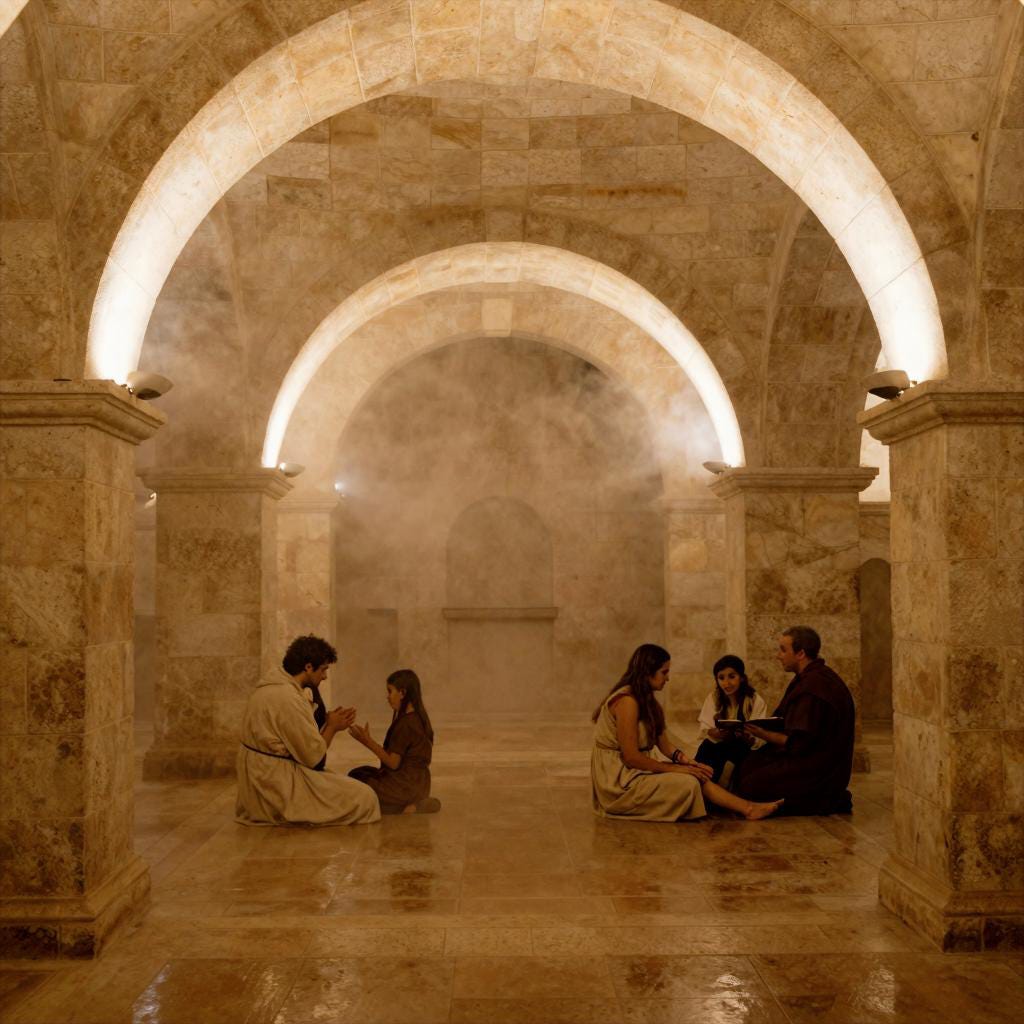
Pull up a chair again, mate. Let me take you on a quiet wander through some old stories — the kind most of us never heard in Sunday school. I’ll give you fair warning up front: parts of this might sound strange, even a bit shocking at first. But that’s not because they’re new ideas. It’s because we’ve forgotten just how ordinary they once were.
If you’ve ever thought, Surely Christians have always been weird about bodies, you’re not alone. A lot of us grew up thinking folks baked discomfort around skin, shame about flesh, and suspicion of embodiment into the faith from the very beginning. But if you could hop in a time machine and visit the early church, chances are you’d come back shaking your head and saying, “Mate, you wouldn’t believe how different things used to be.”
Because the truth is simpler than we’ve made it, God called bodies good long before anyone called them sinful, and for a long stretch of Christian history, people actually lived as if they believed it.
It’s worth starting where the Bible itself starts. In Genesis, before fig leaves, before hiding, before the sudden awareness that something had gone wrong, there’s a line so plain we almost miss how radical it is. The first humans were naked, and they felt no shame. Not embarrassed. Not anxious. Not scanning the garden to see who might be looking. Just human, just present, just whole.
That memory mattered to early Christians. For the first few centuries, they didn’t treat the body as a trap waiting to spring or a liability needing constant management. They understood the body as part of God’s handiwork — something to be honoured, cared for, and lived in, not feared or apologised for. Embodiment wasn’t a problem to solve; God put it there on purpose, right at the heart of what it means to be human.
Now here’s the bit that usually makes people blink and lean back in their chair. For the first few hundred years of the church, believers walked into the water naked to be baptised. Men, women, and children were baptised separately, with care, order, and respect — but unclothed all the same. No robes, no towels clutched nervously at the last second. Just bodies and water.
Why? Because baptism wasn’t just a symbol back then, not the way we tend to make it today. It was a return. A reenactment of creation. A way of stepping back into the truth that we didn’t need to hide a thing from God. Going into the water naked was a physical confession: This is who I am before God — unarmed, unmasked, and unashamed.
Early Christians understood something we’ve largely forgotten. Clothing can cover more than skin. It can cover fear. It can cover shame. It can cover the parts of ourselves we worry God might see too clearly. Baptism stripped all that away, not to humiliate, but to heal.
Try telling that story in a modern church foyer, and you’d probably see deacons fainting into the pot plants. But for centuries, it made perfect sense.
Here’s another piece of history that tends to raise eyebrows. In the ancient world, communal bathing wasn’t scandalous. It was ordinary life. Families bathed together. Friends bathed together. Whole communities bathed together. And Christians did too.
Not because they were careless. Not because they lacked morals. But because they didn’t see the body as a threat that needed constant policing. Bathhouses were social spaces, places of conversation and connection, and Christians brought their faith with them into those spaces. They talked about Jesus, forgiveness, generosity, and neighbour-love while washing dust off their feet and sweat off their backs.
Picture that for a moment. Theology without fear. Faith without hiding. Bodies without panic. It wasn’t perfect — nothing human ever is —, but it was grounded, relational, and honest. Of course, our world looks very different now — but forgetting how the church once lived makes it easy to assume fear was always the faithful option.
So What Happened? Somewhere along the way, the church drifted — not all at once, and not because anyone stood up and announced, “Right, from now on, bodies are a problem.” It was slower than that, subtler, the kind of shift you don’t notice until you suddenly realise you’re a long way from where you started. A few things nudged us off course: Greek ideas crept in that treated the soul as clean and the body as suspect; anxiety about sexuality led leaders to tighten rules instead of teaching wisdom; monastic movements brought deep devotion but also a growing suspicion of ordinary physical life. Bit by bit, modesty stopped being about respect and started being about fear. None of this came from Jesus. None of it came from Genesis. None of it came from the God who shaped humanity from dust with His own hands and called the result good. But fear tells a convincing story if you give it enough time, and eventually it rewrote the script. We shifted from seeing the body as a gift to treating it as a danger, from living with nothing to hide to believing everything needed covering — from naked baptisms to youth-group dress codes. And if that doesn’t make you let out a weary little laugh, it probably should.
The real tragedy isn’t that certain practices disappeared. It’s that we lost our imagination. We forgot that early Christians trusted God with their bodies. We forgot that they saw embodiment as part of discipleship, not a distraction from it. We forgot that early Christians knew holiness showed up in skin and bone every bit as much as in thoughts and prayers.
As that memory faded, shame crept in. Not loudly. Not overnight. Just quietly, like a draught slipping under a door. When we lose this story, it’s our children who inherit the confusion — growing up unsure whether their bodies are gifts or liabilities. Before long, we were teaching kids to fear what God had called good, teaching adults to hide what God had made, and teaching whole communities to treat the body as a problem rather than a place where grace might meet us.
Now, I’m not suggesting we all start building bathhouses or stripping down for baptisms next Sunday. That’s missing the point entirely. This isn’t about reenacting the past. It’s about remembering what the past already knew.
Our ancestors in the faith weren’t afraid of bodies. That fear came later. And anything we learn in fear, we can unlearn in freedom.
Christian Naturism isn’t about nostalgia. It’s about recovery. It’s about remembering that God made bodies good, and that shame, fear, and hiding were never part of the original design. The gospel has always been calling us back — back to wholeness, back to honesty, back to a way of living where faith and flesh aren’t at war. The God who walked with naked humans in a garden and called it good hasn’t changed.
In the next chapter, we’ll spend time with Scripture — not the handful of verses people often lob around in arguments, but the deeper story the Bible tells about bodies, shame, and freedom. Because once you see how the early church lived, a simple truth becomes hard to ignore. We didn’t get weird about bodies because God changed. We got weird because we forgot. And remembering is often the first step toward healing.
So stay at the table, mate. We’ve still got a fair bit of ground to cover — honest, unhurried, unhidden
Can you please site any scripture you might know of depicting nude baptism. Thanks in advance.
Thanks, that's helpful. Look forward to more discussion as you continue to post.